When Cylinder Oil Gets More Expensive, Every Gram Matters
While shipowners have limited control over cylinder oil prices, they have more influence over how efficiently their engines use it. Could your existing lubrication system be consuming more oil than necessary?
Rising cylinder oil prices put pressure on operating budgets
Cylinder lubrication represents a significant recurring expense for vessels equipped with large two-stroke engines. As lubricant prices fluctuate, even relatively small increases can have a considerable impact on annual operating costs.
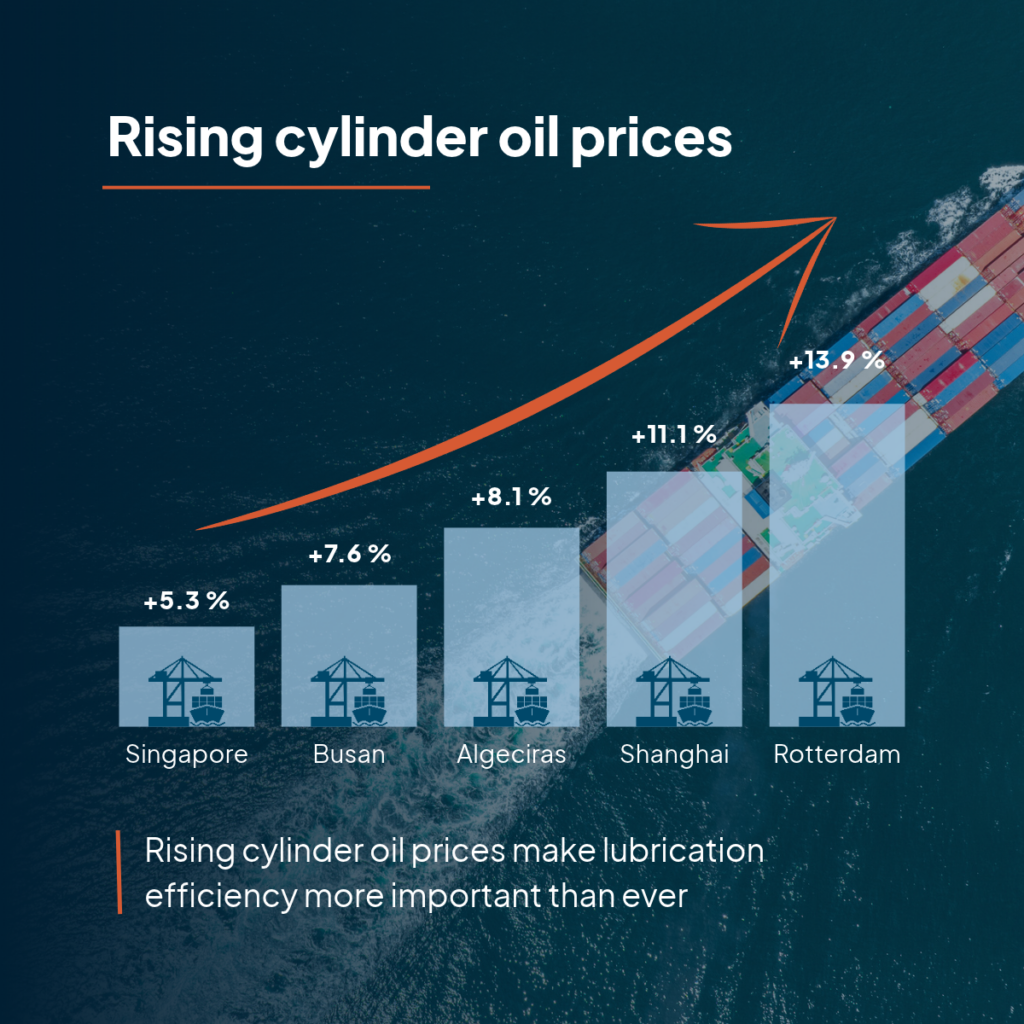
According to marine lubricant procurement platform Closelink, cylinder oil prices increased across several major ports in April 2026 compared with first-quarter averages. Reported increases included:
- Rotterdam: 13.9%
- Shanghai: 11.1%
- Algeciras: 8.1%
- Busan: 7.6%
- Singapore: 5.3%
These figures represent price developments in selected ports rather than global trends, but they highlight how lubricant price fluctuations can affect vessel operating costs.
For shipowners, this makes it increasingly relevant to examine not only the price of cylinder oil, but also -the overall consumption.
A lubrication system that works is not necessarily optimised
Most vessel operators have little reason to question a cylinder lubrication system that performs reliably. If the engine operates without lubrication-related problems and inspections show acceptable cylinder condition, replacing functioning equipment may seem unnecessary.
However, a system can provide adequate protection while consuming more cylinder oil than necessary.
The difference between a functioning system and an optimised one often lies in how effectively it distributes lubricant across the cylinder liner. Uneven distribution may require operators to maintain higher feed rates to ensure sufficient protection.
This raises an important question for technical managers: Could the existing system achieve the same results with less oil?
Why oil distribution matters more than oil quantity alone
Effective cylinder lubrication depends on more than the volume of oil injected . The lubricant must reach the areas where protection is needed and ensure a uniform oil film on the cylinder liner surface. .In conventional cylinder lubrication systems, piston rings help distribute oil across the liner surface. However, oil distribution may not always be uniform. Some areas may receive more lubricant than necessary, while others receive less.
HJ Lubricators developed the patented Swirl Injection Principle (SIP) to address this challenge.
Rather than relying primarily on the piston rings, SIP technology uses the scavenging air swirl to distribute injected oil throughout the entire cylinder liner surface, including the upper liner area where lubrication is particularly critical. . This creates a thin, uniform oil film that makes better use of every gram of lubricant. As a result, operators can potentially reduce cylinder oil feed rates without compromising engine protection.
Lubrication efficiency is not determined solely by how much oil enters the cylinder, but by how effectively that oil protects the engine.
Real operating experience demonstrates the potential
The benefits of improved lubrication efficiency are reflected in HJ Lubricators’ experience with existing installations.
AET: M/V Eagle Varna
Following the installation of HJ SIP valves on M/V Eagle Varna, the vessel achieved a reported 32% reduction in cylinder oil feed rate.
Based on the lubricant price used in the published customer case, HJ Lubricators estimated annual cylinder oil savings of approximately USD 100,000.
The installation coincided with engine overhaul work and piston-ring replacement, so the result reflects the overall project rather than the isolated effect of the valves.
Ugland Marine: Fleet lubrication optimisation
Following an upgrade involving HJ Lubricators’ Lubtronic 2.0 system and SIP valves, Ugland Marine reported approximately 55% lower lubrication oil consumption.
The project also delivered improvements in cylinder condition and operational stability.
Both cases demonstrate the potential of optimising cylinder lubrication through existing SIP technology and broader system improvements. They do not represent guaranteed performance results for SIP+.
Making improved lubrication efficiency easier to achieve
Although improved lubrication technology can offer significant long-term benefits, installation requirements may discourage shipowners from upgrading equipment that still functions reliably.
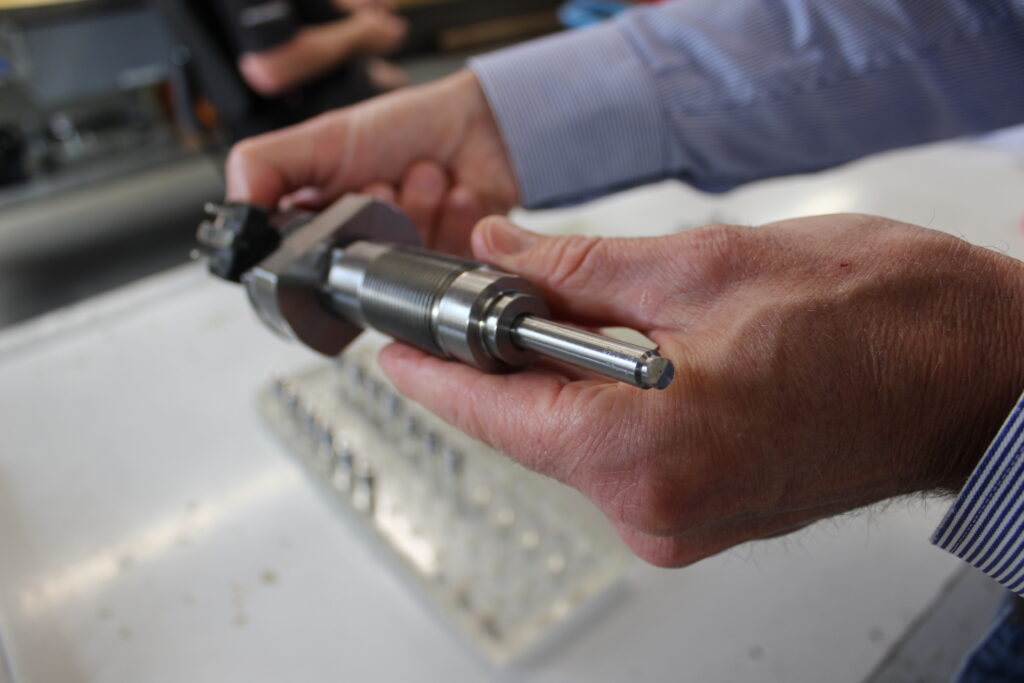
HJ Lubricators addressed this challenge when developing its latest SIP+ valve.
Building on decades of experience with SIP technology, the new design maintains the established lubrication principle while simplifying installation on existing engines.
Earlier SIP installations required machining from inside the cylinder liner, which could involve considerable installation time and operational disruption.
SIP+ eliminates the need for internal cylinder liner machining and top-cover removal, making the retrofit process less complex and potentially reducing both installation time and associated costs.
This makes it easier for shipowners to consider lubrication improvements without committing to extensive engine modifications.
Evaluating the potential for optimisation
Not every vessel will benefit equally from a lubrication system upgrade. The potential depends on the engine’s operating conditions, current feed rates and cylinder condition.
HJ Lubricators help shipowners and technical managers assess these factors using existing operating data, liner inspections and scrape-down oil analysis. This allows the team to identify potential improvements and establish whether a retrofit makes technical and financial sense for the individual vessel.
Any feed-rate adjustments must follow engine manufacturer guidelines and be supported by ongoing condition monitoring.
The decision to upgrade should be based on measurable improvement potential, not simply the availability of newer technology.
Making every gram count
As cylinder oil costs continue to influence vessel operating budgets, understanding lubrication efficiency becomes an important part of managing long-term operating expenses.
The starting point is not necessarily replacing equipment or reducing feed rates. It is assessing how the existing system performs and whether there is a realistic opportunity to improve it.
HJ Lubricators combines engineering expertise, operating data and experience from existing installations to help shipowners make informed decisions about cylinder lubrication.
Discover your vessel’s potential for cylinder oil savings
Every vessel has different operating conditions and optimisation potential.
Find out whether your current lubrication system could deliver better results with a vessel-specific assessment from HJ Lubricators.
Explore your potential cylinder oil savings or request a vessel-specific assessment.